"Excellent service very professional and great value tyres. Pleasant doing business with them."


EU tyre labels were introduced in 2012 to help drivers make informed choices. They give key information on three main areas: fuel efficiency, wet grip, and external noise. Each area is rated on a scale of A (best) to E (worst) for easy comparison.
The label was updated in May 2021. With fewer categories, the A-E scale for fuel efficiency and wet grip became simpler. As indicated by the pictograms, a new section on snow and ice performance was added. There's also a QR code for detailed product information and a unique identifier for each tyre.
The goal is to empower drivers to choose tyres that suit their needs and driving conditions. For instance, prioritising fuel efficiency might lead to an A-rated tyre, while someone needing winter performance would look for the snow pictogram. Ultimately, EU tyre labels help promote safety, environmental awareness, and fuel economy.
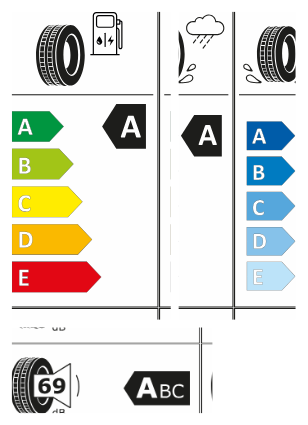



There is some newly designed information to find on the updated version of the EU tyre label. Here’s the new design of the EU tyre label explained in a nutshell:
The inclusion of a QR code provides easy access to product details in the public part of the EU product database. The code can be scanned and grants access to product information sheets and european tyre labels.

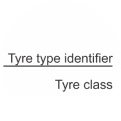
Each tyre product must identify through a unique tyre designation.
There are two new options for including an additional icon. The snow tyre icon shows, if a tyre is suitable for severe snow conditions. It bears a three-peak mountain snowflake symbol (3PMSF) that is incorporated in the sidewall of such tyres. The pictogram is granted by measuring the braking distance of a car from 25 mph on compacted snow or by measuring the traction force of a tyre. For a truck, the pictogram is granted by measuring the acceleration performance of a tyre. Snow grip performance in general is tested in accordance with Annex 7 to UNECE Regulation No 117. The regulation describes in detail such factors as test surface, air temperature, testing vehicle, load, pressure, speed, and many more.

The second new icon features a symbol of an ice stalagmite and indicates that a tyre provides a shorter braking distance on ice covered roads in winter. Information on ice grip performance will be based on the ISO standard (ISO 19447), which is expected to be published in July 2021. For tyres meeting the technical requirements, the ice grip pictogram will be included on the new EU tyre label of a C1 tyre (passenger car tyre), which satisfies the minimum ice grip index values set out in that ISO standard. The pictogram is granted by measuring the braking distance of a car from 20mph on pure ice. The standards for C2 and C3 tyres are still to be defined.

 Excellent on Google
"Excellent service very professional and great value tyres. Pleasant doing business with them."
"Regular customer here, friendly honest staff who go the extra mile for you. Good value tyres too. Highly recommended."
"Great staff great prices really quick and efficient. Thanks Guys!"
"Great and quick service, helped us out when we were in a rush to the airport and had a flat tyre!"
"Been using this place for the last six years since living in Ballyclare, I find the staff friendly and helpful, I would have no problem recommending to anyone."